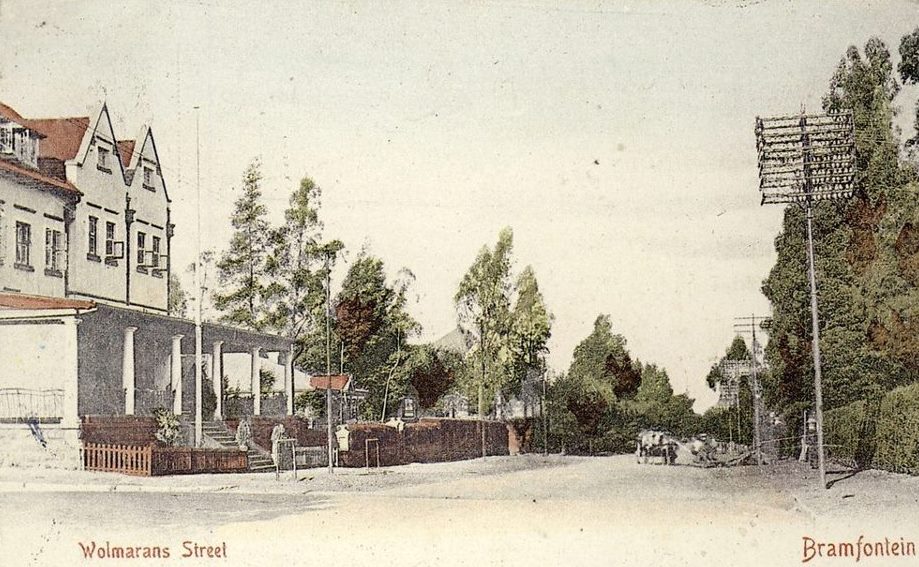
I’ve come across yet another suburb name that a part of Braamfontein was once known as: Argyle (or Argyll). This was once known as Johannesburg’s smallest suburb and was a few blocks west of the old Johannesburg Hospital. According to Anna Smith’s ‘History of Johannesburg street names’, the Transvaal Volksraad granted Commandant Daniel Egnatius Schutte land on Raandjeslaagte in 1893. He acquired more land in the vicinity of the general hospital, De Korte and Simmonds Streets between 1894 & 1898. As such, the area was also known as Schutte’s or Schutte’s Ground.

In June 1903 Messrs. Arthur Barnett & Co took over the lease and laid out the small suburb and 31 stands were sold on 26 May 1903. The name Argyll commemorates the fact that the Argyllshire Highlanders camped on Schutte’s ground for several months in 1902.

In the first part of this History of Braamfontein series I mentioned, under the section on ‘Clifton’, that land was donated to the government and churches and a post office were built on it. I posted pictures of the Clifton Methodist Church which was demolished in 1973.
Here is information and pictures on the Dutch Reform Church and the post office as well as other ‘Lost’ Braamfontein buildings and houses.

Braamfontein Post Office
This is one of three similar post offices designed by Sytze Weirda’s Public Works Department (the other two were in Jeppe and Fordsburg with Jeppe being the only one still standing). Weirda was Chief of Public Works for ZAR and designed the Rissik Street post office, Plein Street Telephone Tower as well as other government buildings in Johannesburg and Pretoria. The Braamfontein post office (which was identical to the one still standing in Jeppe) was built in 1898 and opened in September of that year on the corner of Biccard and De Korte Street. According to Anna Smith’s ‘Johannesburg Firsts’, it was the first suburban post office to be built. It was demolished in 1966 to make way for a bigger and more modern post office building.


It was in Clive Chipkin’s book ‘Johannesburg Style’ where I first read about Weirda’s three post offices. Fordsburg was not mentioned but I can confirm that plans exist for a post office in Main Road Fordsburg on stand #90. There is no original building date but there are listings for alterations and additions from 1908. The architect is listed as ‘C.J. Gyde – Public Works Department’ of which Weirda was the head. From the only picture I’ve found, one can see the style is in-line with the other two although for some reason, Fordsburg is not identical to the other two.


Dutch Reform Church
This church, bounded by Jorrisen, De Korte and Harrison Streets, dates back to 1897. A year later, a parsonage was added for the Rev. A. Martens which was erected on the Harrison Street side. This addition was designed by Reid & Green. The old church was demolished in 1955 and replaced by a modern church building, which itself was demolished in the 1970s or 1980s


Pirate Bottle Store
Just a few blocks down from the Methodist Church stood the Pirate Bottle Store on the corner of De Korte & Biccard Street. It was owned by liquor merchants Jooste & Bryant whose original building still stands in Jeppe (and is the only building left in Johannesburg with the iron lettering still on the roof). It was built in 1894 and designed by Charles R. Snell. In 1897 and an additional warehouse/shed was added by Snell & Waterson. The store with its iron lettering on the roof can be seen vaguely in the picture below.


Freeman Cottage and shops
This was across the road from the Milner Park Hotel, or Kitcheners, as it’s known today. It was a cottage/shop designed by H.A. Goodman for Mr. Freeman and dates back to 1894. It was common for shop owners to live on the premises.

Clifton Hotel
This hotel was diagonally across the road from Kitcheners and built in 1899 for owners Bisschop, Mesdas & Co. There were many similarly designed hotels in the area of which Kitcheners and the Devonshire Hotel (further down) are good examples.

South African Hotel
This is another example of a typical hotel which was on the corner of Wessels and Juta street across from the Braamfontein Cemetery. Braamfontein lost Graaf & Wessels Streets to the M1 highway in the late 1960s.


Devonshire Hotel
Official sites date this hotel to the 1930s but one can see from the early pictures that it was more likely to have been built around late 1890s – early 1900s as it is in the same style and structure of other hotels in the area with verified dates. The original building no longer exists.


Sacke Residence
The residence for S. Sacke on the corner of Wolmarans and Loveday Street designed by Harry Clayton in 1892. In 1939, on the same stand, a block of residential flats was built for owners Leeds Buildings LTD. Today, it’s an open piece of land with the flats having been demolished at some point.

Geldenhuys Building
On the corner of Wolmarans and Harrison Street is 1896 Geldenhuys Building which is now known as Akhalwayas 2005 Building. The bottom floor used to be occupied by Corbett Bros Family Grocers. The top floor were presumably flats. The pictures below show a then-and-now comparison. Note how the ornate 1st-floor veranda is no longer there. The Sacke residence mentioned above would have been to the left.


Masonic Temple
On one of three corners of Juta and Harrison Street stood a Masonic Temple (one corner was the Clifton Methodist Church. Two of the corners are now just street-level car parks and the other across the road from Damelin is a Parkade). It was built in 1906 for the Trustees of Scotia Lodge No.973 and designed by May & Christie.
There are two lodges I found attributed to Braamfontein: Scotia Masonic Hall is listed as being in Braamfontein and was one of the meeting places of Richmond Lodge (1904). Clifton Lodge met at Clifton (?) in Braamfontein amongst others like the Masonic Temple in Plein Street and the Freemason’s Hall in Parktown. Perhaps Clifton & Scotia Masonic Hall was the same temple used by both lodges. I’ve yet to find any pictures of this building but the plans below will give some indication as to what it looked like


Synagogue on Smit Street
Below are plans for the synagogue for the Braamfontein Hebrew Congregation on the corner of Smit and Loveday Streets. I’ve not come across any other information on this building but will update when I do. According to the plans it was designed by S. Isaacs and dated 1919.

Buildings and houses lost to the Civic Centre
In 1950 it was established that a Civic Centre was needed. Further planning was deferred until 1953 due to a lack of funds. In 1954 the council started negotiating with the home and property owners on the land earmarked for development. This was completed by June 1960. Demolitions, road closures and site clearance followed. A design competition was held and the winning design was picked in 1962. By 1967, excavations for the underground parking and basement levels were on track. Contracts for the two blocks were awarded (around some further financial constraints) and the Civic Centre was completed in 1971. The one-way system around the Centre (which still exists today) came under some criticism. It was explained that the purpose was to ensure that officials arriving to work late didn’t collide with those leaving early… a light-hearted observation I’d imagine.


Below is an interesting picture of Braamfontein taken from the air looking north toward Parktown. I estimate it was taken around the mid-1950s based on the Dutch Reform Church not being there. It shows a good view of the suburb before the Civic Centre and Theatre complex. Only a handful of the buildings in the photo below exist today *CLICK for full image*

Spes Bona School
This school was built in 1905 and designed by the Public Works Department. It was originally known as Hospital Hill School. Around 1909 it became the Spes Bona School and presumably stayed a school until it was demolished to make way for the Civic Centre. It was bounded by Stiemens, Jorrisen, Rissik and Joubert Streets.

All Saints Clifton Parish Hall
This was a church built in 1906 and designed by Thomas Anderson Moodie. In 1933 an organ was added as per the plans below. Note on the plans how ‘Clifton’ has been crossed out and replaced by Johannesburg. Alexander Forest was the architect of the organ chamber addition.


Congregational Church
This church was built in 1897 on Loveday Street. It was designed by Howden and Chandler. The plot of land on the corner of Loveday and Stiemens was developed in 1909 for one of the Reverends but there also appears to be plans for a proposed church on that site. I’m not sure if it was ever built, as the 1909 plans show the stand with the house and the church next door and the 1897 plans show the stand as vacant.

House for Congregational Church Reverend Charles Phillips
I found reference and plans for a residence for Rev. Phillips from 1909. This house was built on the corner stand of Loveday & Stiemens Streets as mentioned above. The area where the church and house stood is now an open grassed area in front of the Civic Theatre.

Civic Centre houses
These pictures were sent to me by Japie Bosch (as well as the Civic street plan) and show various houses in Ameshoff Streets in the vicinity of the future Civic Centre from 1948 – 1952.


Below are various examples of buildings, flats and houses that have been demolished over the years. Unfortunately, I don’t have the exact locations for many of these.


A recent loss to Braamfontein in 2014 were these last remaining houses on Henri Street


© 2014 Johannesburg 1912. Please don’t copy our content or images without permission — we work hard to research and produce everything you read here. If you’d like to share something, please link back to the original post. Thank you for respecting our work.


 Johannesburg 1912 - suburb by suburb research
Leave a reply to Lost Braamfontein | Marc Latilla Cancel reply