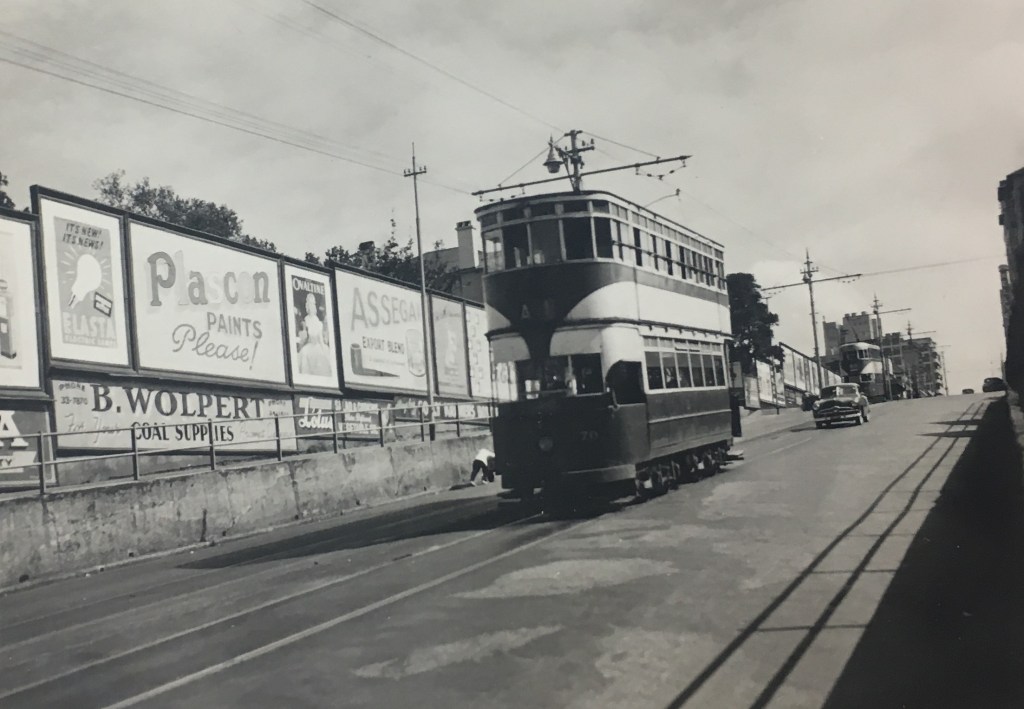
Since moving this blog from Posterous (RIP), the traffic has more than doubled and for the first time I’m also able to see what people searched for to get to my blog. A few weeks ago there was a spike in ‘tram’ searches so I decided to slot a quick history of trams in-between the Belgravia posts. First though, some interesting road facts…

The oldest road is reputed to be the Heidelburg to Rustenburg road. It was originally a wagon trail and remnants of it have evidently been preserved at WITS campus. Looking at old maps, the road today appears to be the same Rustenburg Road that snakes through the bottom of Melville and reappears in Victory Park. Part of the original road also became Barry Hertzog. This road or track existed before the discovery of gold.
It is said that Melville koppies, Parktown ridge, and the Mondeor koppies were barren, rocky and almost treeless but looked much the same as today (minus the houses of course). In December 1886 there was only one tree in the whole of Randjieslaagte situated in Church Square which became Von Brandis Square – where the law courts are today.
The first road in Johannesburg was Commissioner street. It linked Ferrieria’s Camp to Jeppestown and was created by filling three ox-wagons with rocks and dragged them up and down in a straight line for a week. With the fast influx of people and increased mining needs, transport became an issue. Most roads in the town (right up to mid-1910) were still mostly sand without pavements, curbs or drainage. Attempts to macadamize the roads were made difficult by continuously overloaded wagons and heavy rain which both damaged the roads.
Johannesburg only got a proper railway in 1892. This was 2 and-a-half years after the isolated Rand Tram was set-up to transport coal from Boksburg. The Rand Tram would form the basis of Johannesburg’s future railway. Before that, all goods were transported into the town by wagon from either the Cape or Durban from wherever those railway lines ended. It is said the road (or wagon tracks) to Johannesburg were paved with skeletons of countless draught animals that died from hunger, thirst or exhaustion along the way.

The Rand Tram line ran east to west through the Randjeslaagte triangle. The mining camps and building development on the blocks laid out between Commissioner and Noord Streets presented a physical barrier, so the line was forced to skirt this barrier on the north side. In order to get back to alignment serving the mines the line had to curve through Doornfontein, Troyeville And Jeppestown seriously disrupting their block layouts. The Jeppe & Ford company consented to the line running through Jeppestown on condition all trains stopped at School Halt (named after St. Marys which later became Jeppe Halt and was also the busiest Halt after Park Halt at the end of Eloff street – now the Johannesburg Railway Station)
Arriving in 1889, the first town engineer, William Henry Miles from Bournemouth, supervised the laying of the first tram lines. In 1891, the first horse tram moved out of the Market Square terminus. Horse drawn tram lines were limited to town, Braamfontein, Hospital Hill, Fordsburg, Jeppe, Belgravia, and Doornfontein, totaling 11.5 miles of track by 1893. The horse tram sheds were located on the north side of Staib Street. Within a few years, double-decker trams were introduced and serviced the city for many years. The last horse-drawn tram trip was made to Braamfontein on 14 July 1906, five months after the introduction of the electric tram, and co-inciding with the date of the opening of the Melville electric line. The #8 horse tram survives in the James Hall Transport Museum.


A major problem in planning the trams was the railway line which effectively cut the town in half. To get around this, bridges and subways had to be built because the existing level crossings were becoming too dangerous and difficult to maintain with the increase in traffic. In 1904 the Twist Street and King George bridges were built. The Main Street subway in Jeppe was finished in 1905, Braamfontein/Harrison Street subway in 1906, Siemert Road Doornfontein in 1910 and the Vrededorp subway in 1913.

The outbreak of the war put stop to plans to move to an electric tram system. The electric tram and the power station to supply the electricity was started in 1905. By mid-1906 most of it was completed. The first service from Market Square to Siemert Road railway bridge took place on 14 February 1906. By the end of the year 14 routes were in service.

Of interest are two accidents: On 5 December 1906 tramcar No.51 overturned in Berea on the corner of Tudhope Avenue and Abel Road, and on 27 March 1907 two cars collided at the bottom of Twist Street due to a locust swarm. By 1925, the overhead tram lines reached a distance of 136km and serviced by 191 cars. Before WW2 there were 242 tramcars plus another 138 motor buses and 38 trolley buses that serviced other routes. With the increase of traffic in general from the 1930s, negotiations began to lower the railway lines starting with Jeppe. This work started in 1936. The Main Street subway was eliminated (See picture of this subway here) and new bridges built at Nugget Street, Cleveland, Denver, Tooronga, Geldenhuis and 6th Ave, Mayfair.
The tram system was far from efficient. In the early 1930s, the suggestions of the Spencer Commission revitalised the system. Most improvements took place in 1935 and 1936 and resulted in higher passenger numbers than before. Poor routes like Wolhunter and the southern suburbs were converted to diesel buses while busy routes saw the doubling of tracks.


Originally known as No. 2 shed and built in 1926, this depot was used as a bus repair garage until 1931. It was extended in 1935 to house trolleybuses and after 1938, it also housed surplus cars. In the 1970s the building was converted into a garage for the double-decker buses that replaced the tram system after the tram network was dismantled in 1961. It remained in operation as a garage until the 1990s. The Bus Factory, as it’s known today, was renovated and part of it turned into offices for the Johannesburg Development Agency in the late 2000s. Along with the JDA offices, the complex is also home to various theatre, art, and photographic organisations, with space regularly used for various cultural exhibitions.


The high incidences of tram accidents and derailments from after WW2 right up until the late 1950s sustained the campaign for anti-trams. An increase in car traffic along with dropping passenger numbers and aging equipment helped the demise.


By 1955 it was decided that most of the trams were at the end of their useful life and would be replaced by trolley-buses over a period of seven years. The last trams ran on 18 March 1961, exactly 70 years after the first horse-drawn tram left Market square. The very last electric tram, a 40-year-old double-decker, was driven by the mayor of Johannesburg Dave Marais. In his farewell speech he said, “It is said, that there is no room for trams in a City like Johannesburg”.
This selection of photos was taken on the last day of the trams


Read this wonderful piece written by Steve Hayes who was the last tram conductor to be hired by the JMT. On his third day as a new conductor, he worked the last scheduled tram service on Friday 17 March 1961.
Check out Mark Straw’s photo collection of the last tram taken at the James Hall Transport museum here.
Here are trolley bus videos from 1980 and 1973 showing various buses traveling around the city and suburbs of Johannesburg shortly before they were decommissioned.
This video shows some footage of the last tram ride in 1961 (even though it’s labeled 1930s)
These are the trolley bus and tram route numbers c1950
Here are some pictures of a recently acquired 1931 map of the Johannesburg tram system


© 2013 Johannesburg 1912. Please don’t copy our content or images without permission — we work hard to research and produce everything you read here. If you’d like to share something, please link back to the original post. Thank you for respecting our work.
Reference:
Van Rensburg, C, 1986. Johannesburg – One Hundred Years. Johannesburg: Chris Van Rensburg Publications
Grant, G & Flinn, T, 1992. Watershed Town-History of the Johannesburg city engineers department. Johannesburg: Johannesburg City Council
De Jong, R. T., Van Der Waal, G-M. and Heydenrych, D. H, 1988. NZASM 100 – 1887-1899. The buildings, steam engines and structures of the Netherlands South African Railways company. Pretoria: Chris Van Rensburg Publications
Spit, T. 1976. Johannesburg Tramways. London: The Light Railway Transport League
Wentzel, J, 1975. A View from the Ridge. Cape Town. David Philip
Updates:
General text additions, factual corrections and new photos 15 September 2018


 Johannesburg 1912 - suburb by suburb research
Leave a reply to Robin Cancel reply