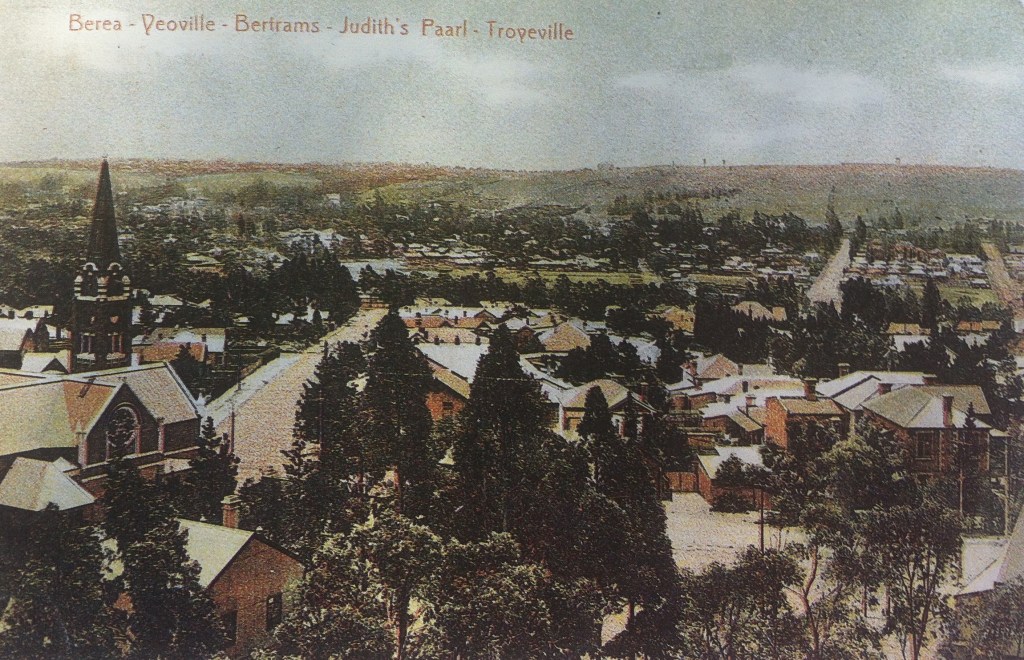
There are very few pictures of early Troyeville but the above postcard is a great landscape shot where one can see the great general changes over a period of just over 100 years. The postcard picture was taken from the Fairview Fire Tower around 1910. The picture below was taken from the fire training tower just behind the Fairview Tower in early 2014 (I wasn’t allowed up the actual tower as it’s a national monument). Most striking for me is seeing Hillbrow in the distance before it was built up (being another suburb where early pictures are rare). Much of Troyeville has stayed the same.

On the 10 August 1889, 612 stands went on sale. It was the only Township started by Hollanders (Van Boeschten & Lorentz) hence all the Dutch street names. It was laid out in June 1891 and named after Gustav Arthur Troye. He was born in Germany in 1860 and came to South Africa when he was 17 and eventually qualified as a surveyor. The layout of Houghton Estate was also his doing. He began compiling maps and later worked for the Barnato Group and the Johnnies (JCI Investment Company) before starting his own practice. Troye lived in Parktown in a house on the corner of Oxford and Valley Road known as ‘The Towers’ although he originally named it ‘Welgelegen’. It was one of the many houses demolished to make way for the M1 highway. The house would have stood right under the highway where the Oxford Road off-ramp is when traveling north, just below Northwards.


In 1892 the layout of Troyeville was changed by W. H. A. Pritchard to roughly how it looks today. The suburb had a slow start due to the recession but slowly started filling up with mostly middle-class residents. In later years the city encroached on Troyeville and other older suburbs close by. Light industry started infiltrating the area (especially the part of Troyeville behind the hotel and down to Ellis Park and along Commissioner Street). Also, many of these suburbs were poorly planned without adequate open spaces as developers tried to cram as many stands into the area as possible. This combination makes these areas less valuable today as pure residential areas even though they have amazing examples of early Johannesburg architecture and buildings. To add to this, Troyeville was one of the many areas in Johannesburg in the 1990s along with Hillbrow, Joubert Park, city centre, Berea, Yoeville, Orange Grove, Bertrams and Jeppe that the major banks ‘red-lined’ and wouldn’t approve bonds for new homeowners. Owners couldn’t sell (unless for cash or private arrangement) and the property prices slumped. Owners either abandoned their properties or sold them off cheap – sometimes to slumlords. A 2013 check on property prices shows that Troyeville is on the increase with a few historic houses selling in the lower millions. Certain parts of Troyeville are in better state than others with houses in the better parts holding their values.
Mansion on Pretoria & Clarence Street


There are no original plans for this lovely house but it’s estimated it was built in 1912. The steep twin gables give it an air of dignity. The building is Edwardian in design. In 1925 it was donated to the Salvation Army and appears to be empty at the moment. After the Salvation Army, the house was owned by The Star columnist Gwen Gill and after her, musician and singer Jennifer Ferguson. Hollard Insurance owned it for some time where it was used as a conference centre. It is now owned by and art collective.
Various semi-detached houses


While it’s common to focus on the buildings, mansions, and churches from a heritage or even preservation angle, it’s important to also shine some light on examples of ordinary houses and cottages from the time. These were built and lived in by ordinary working-class people who were as much part of the early pioneering spirit of the town as the capitalists and big risk-takers. I’ve always included examples in these posts, and these semis are further examples. One only has to compare the stylistic details and solidness of build of those old houses to any new developments going up anywhere today to appreciate their value. Old houses are not for everyone, but for those that love the quaintness and the history (and the fixing up), there is nothing better than being part of and preserving the history of the city.
Sadly though, many great examples of these types of houses are in areas where a house, regardless of its historic importance, is seen only as accommodation in a city where central space is at a premium.
Gandhi’s house 11 Albermarle Street

From the Blue Plaque inscription:
Indian leader Mohandas Gandhi lived here from 1904 to 1906 together with his wife Kasturba and sons Manilal, Ramdas and Devdas. They shared the house with Henry Polak, Gandhi’s friend and colleague in his law office. In 1905 they were joined by Polak’s wife Millie who describes the house in her book on Gandhi:
“The house was situated in a fairly good middle-class neighborhood, on the outskirts of town. It was a double-storied, detached, eight-roomed building of the modern villa type, surrounded by a garden, and having in front the open spaces of the koppies. The upstairs verandah was roomy enough to sleep on it, and indeed in warm weather it was often so used”.
Gandhi left for Durban in 1906 and never returned to the house (although he did return to Johannesburg). It appears that it was once thought that Gandhi lived at no.19. This was dis-proven based on the date of the plans (submitted in 1905) and that Gandhi’s son was taken to No.11 in the 1950s and remembered living there as a child.
David Webster House 13 Eleanor Street

From the Blue Plaque inscription:
Anthropologist and activist David Webster lived here from 1986 until his assassination three years later. Dr Webster played a leading role in the Detainees’ Parents Support Committee, the United Democratic Front and affiliated organisations. He co-founded the Five Freedoms Forum formed as a home for whites in the struggle for democracy. On 1 May 1989, he was gunned down outside this house by an agent of the apartheid regime. Unveiled 23 March 2013.
Troyeville was also once home to the Foster Gang and African jazz musician Gito Baloyi.
Troyeville Park

Troyeville Park was given the residents by the company that took over the land (Troyeville Maatschappij Beperkt) on the 26 March 1907. It was originally known as Bloemen Hof and is now David Webster Park.
Op De Bergen Street forms the boundary between Troyeville and Fairview


According to the old maps, everything on the right was part of Fairview and everything on the left part of Troyeville.
Gem Theatre


This theatre was built in the 1940s and closed down in 1976. It has been used as an art gallery and a live music venue.
Regal Kinema


This lesser-known cinema operated at the corner of Bezhuidenhout (now Albertina Sisulu Road) and Pretoria Street.
Hellier Street

This mansion on the corner of Hellier and Nourse Street combines oriental and modern influences. Hellier Street was originally spelled Hillier Street after Dr A. P. Hillier (1857-1911) who was a director of the Troyeville company. Born in England, he came to Johannesburg in 1893 from Kimberly where he had taken over Dr. Jameson’s practice. Hillier became a member of the Reform Committee and after his release from jail went back to England (not before being allowed out of Pretoria goal on bail to assist 19 doctors, under the supervision of Dr. Bensusan, administer relief to those injured by the Braamfontein explosion. He was chairman of the hospital board at the time). He also contributed a section on South African History in the Encyclopedia Britannica published in 1911.
The current owner of the house since 1991, architect Michael Hart shared the following: The house…on Hillier Street is recognised as being built in the style of Art Nouveau. It was built in 1905 at the same time that Art Nouveau was developing in Europe in particular Vienna and Paris. The Architect was Eugene Chappuis Metzler a Swiss architect who built the house for himself. The building has numerous elements inspired by buildings built in Europe between 1890 and 1905. There are also interesting elements that are a precursor to the Art Deco that followed in the 1920’s.
Williams Street

I’ve come across two references to this street but have not found it on any recent maps. It was named in 1902 after Charles William Partridge by his father L. U. Partridge who privately owned part of the property where the street lay. Although originally named William Street it became Williams Street over the years. It appears to be the present-day Charles Street as can be seen by comparing the sketch by Philip Bawcombe and a current photo of the houses on Charles Street below. In a map from 1895, Pine Street runs under where Williams (now Charles) Street is. Pine eventually joined up with and became the main thoroughfare Bezhuidenhout which connected with Broadway and Roberts Avenue in Bez Valley Kensington. Bezhuidenhout was recently renamed Albertina Sisulu Road.


Spires

There is a large concentration of churches contained within a few blocks of Troyeville and Fairview. The illustration above shows the unique skyline of church and other spires as seen from the Berea ridge across the way. Most of the churches no longer serve the original communities they were built for but are still thriving under different denominations.

Some of the churches


Other mansions and period houses in Troyeville


© 2014 Johannesburg 1912. Please don’t copy our content or images without permission — we work hard to research and produce everything you read here. If you’d like to share something, please link back to the original post. Thank you for respecting our work.


 Johannesburg 1912 - suburb by suburb research
Leave a reply to Inga Molzen Cancel reply