Grand Station Hotel 1896


Built to serve miners from the nearby Wolhunter mine, the Grand Station Hotel is one of the oldest and grandest. It had a close association with boxing and served as a soup kitchen and refuge during the 1922 miner’s strike. The building was designed by Reid & Williams (who were also responsible for six other buildings between 1894 and 1897 – one being the Masonic Temple in Plein Street) and was built by Reginald James Nicholas, a popular builder in Johannesburg. The first owner was Joseph Rabinson who also owned the Fountain Hotel in Fordsburg. Rabinson held boxing matches in both his hotels.
The first big party at the Grand Station Hotel was a Christmas party evidently thrown by gold and diamond pioneer David Pullinger, to celebrate the opening of his Percy Goldmine. David was the younger brother of Edward Pullinger who had a mansion on Pullinger Kop (also named after him) at the top of Nugget Hill. Edward was the one time Deputy Director of Johannesburg’s abattoir and livestock market.


When looking closely at the pictures, be aware that the Grand Central Hotel’s position can be deceptive depending on which direction it’s looked at. There is a short (Maddison Street Facade) and long side (Main Street facade)
Most of the hotel’s interior décor (woodwork, fireplaces, delft tiles) was replaced in 1966 in order to comply with Hotel Board requirements. It was fondly known as ‘Norman’s Grill’ for many years and had a reputation for serving the best prawns in Johannesburg. Norman Gaffen took over the hotel from his father, Jacob Gaffen, after his death in 1938. Norman was 16 years old at the time. Jacob originally acquired the hotel in either 1918 or 1921 from Mr Rabinson. The grill was still going in the early to mid-1980s. Norman Gaffen died in December 1986.
Jeppe Post Office 1897

Although plans can’t be traced, it’s believed the Jeppe Post Office on the corner of Main & Gus Street was designed by Sytze Wierda of the Public Works Department. He was also responsible for Rissik Street, Fordsburg (demolished) and the old Braamfontein Post Office (demolished) as well as the three-story telephone tower in Plein Street (demolished). The foundation stone for the Jeppestown Post Office was laid on 15 December 1897 and it was completed about a year after the Rissik Street Post Office.

The post office is one of seven public buildings that the Public Works Department of ZAR erected in Johannesburg. They favoured the Second Empire style combined with Dutch influence.

Dropping the train tracks 1936-1940
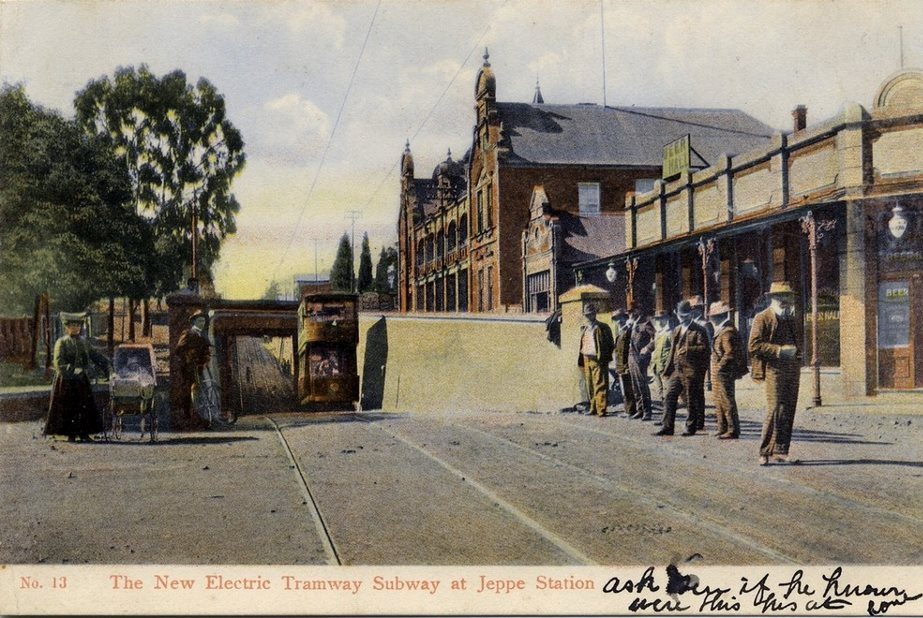
There are few alive today who will remember the subway in Jeppestown. Originally, the train tracks were on street level. Rather than build a bridge over the tracks for trams, the street was lowered in 1906 under the tracks creating the subway.


This subway was demolished in 1937 when the train tracks were lowered (adjacent to the original tracks) and the traffic and trams were brought back up to the street level to improve access to Jeppe and beyond. The old tracks were tarred over to become John Page Drive.


Work started on this project in 1936. Bridges over lowered tracks were also built at Nugget Street, Cleveland, Denver, Tooronga, Geldenhuis and 6th Ave, Mayfair. The aim of the project was twofold: first was to improve traffic flow as the number of cars on the roads was increasing, and the second, was the modernisation and expansion of the Johannesburg station. According to the Transnet librarian Yolanda Meyer, there was virtually no interruption to the train schedule.
An oddity around the dropping of the tracks in the Jeppe area was that the dropped tracks were constructed next to the existing tracks. In some cases, land and buildings were expropriated for this expansion.
Lithuanian Synagogue 1903
An old Lithuanian Synagogue in Jeppe, right in the path of the new dropped tracks line, managed to survive even though part of the building was chopped off.
An industry colleague, Nic Burger, sent me a google screenshot a few years ago about a shul in Jeppe that was cut in half, likely to do with the railways. Research has revealed that it was built in 1903 and designed by George (Snowball) Laidler and was built by Mr Muldoon for the Jeppestown Hebrew Congregation made up of Eastern European Jews or ‘litvaks’ who lived in the suburb.
It was the first purpose-built suburban synagogue in Johannesburg. Another Eastern European congregation established a synagogue in Ferreirasdrop in 1891 in Fox Str, but it was housed in a residential home and later moved to a modified home also in Fox Str. The proper synagogue was only built in 1912. This was a breakaway group from the original President Str synagogue and the ‘Yekkes’ British and German jews. Eastern European congregants felt the services weren’t orthodox enough. Before this, there was the Fordsburg synagogue which was was built in 1906.
The foundation stone of the Jeppe synagogue was laid by Max Langermann on 27 July 1903. He was president of the Witwatersrand Old Hebrew Congregation. The building opened on the 6th of September 1903 and was consecrated by Rabbi Hertz of the WOHC.
It was the centre of Jewish life in the suburb along with the Grand Station hotel where all the bar mitzvahs and weddings were held, but over time had become too small. After a 1924 resolution. The stands and buildings were sold in 1926 with the condition the site could not be used for worship or entertainment. A new, bigger synagogue was to built in Browning street on land that had been purchased in 1920.
This was the Jeppestown Synagogue a few hundred metres away from 1926 covered in the next part.
Frank Waterman purchased the building. Around the time of the expansion, the old synagogue was used as factory storage space. In the mid-1930s the railways expropriated 32 full stands and 8 portions of existing stands of which the old shul was one. The railways demolished the southwestern portion which included the original entrance which was on Janie street.
They closed off the southwestern side and incorporated the windows into the remaining structure. The B&W photos show the interior of the building which are different to the ones I took in 2014.


© 2013 Johannesburg 1912. Please don’t copy our content or images without permission — we work hard to research and produce everything you read here. If you’d like to share something, please link back to the original post. Thank you for respecting our work.
Reference:
Johannesburg Historical Foundation, undated. Some Historic Drives & Walks of Johannesburg. Written and produced by the JHF
The Star. 1971. ‘Saga of a famous hotel’ by Denis Godfrey.
Norwich, O. I, 1986. A Johannesburg album-Historical postcards. Johannesburg: AD. Donker
Yolanda Meyer & the Transnet Heritage library
Updates:
Added additional Lithuanian Synagogue photos and updated text from JHF presentation Nov 2021
Added information and new photos on dropped tracks and Grand Station Hotel plans May 2019


 Johannesburg 1912 - suburb by suburb research
Leave a reply to Charles Cancel reply