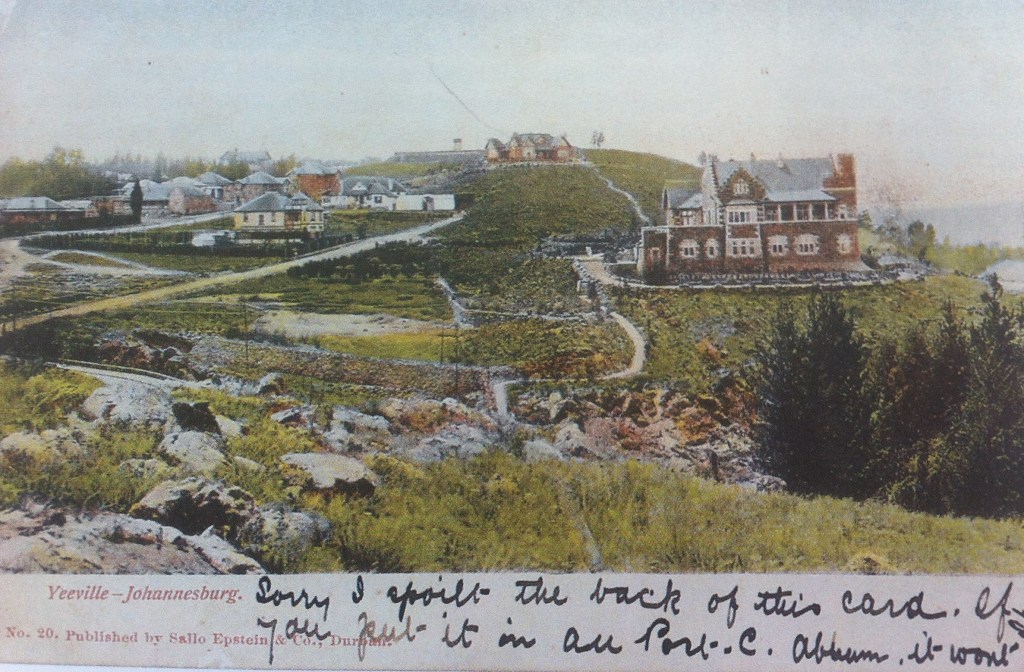
It appears as though I’ve mistaken my mansions (or at least the reference books I’m using have) as I’ve always believed the house that once stood on the hill on Harrow Road across from where Ponte is now was known as THE TURRETS. It was in fact called EASTINGTON which was built from koppie stone in 1902 for John Dowell Ellis who was Johannesburg’s Major between 1911-1912. It was also known as ‘the castellated crag of Yeoville’ and had a magnificent view of Johannesburg and the mines to the south. The Ellis’ held regular garden parties and receptions in the garden.

The Turrets, built in 1896, was actually a short way down the hill in Louisa Street (corner of Harrow Road) that ran parallel to Saratoga and was at different times the home of Barney Barnato, George Albu & the Friedlanders (Mrs Friedlander, wife of the stockbroker J. F. Friedlander, built the house originally) before becoming a Jewish old age home. The home, established in 1912 after the Albu’s moved to Northwards in Parktown, was opened in 1918 and expanded in 1936 by the addition of a convalescent home and a double story woman’s wing in 1939. It was all demolished in the late 1960s and Louisa street now no longer exists as it now forms part of the old WITS Tech (now UJ). There would have been a bunch of houses demolished to make way for the tech as was done in Parktown in the 1970s for the teachers college and JHB hospital.


Sam Jameson, brother of Dr. Jameson of Jameson Raid fame, had a cottage on the corner of Louisa and St. Augustine’s Street. It was later converted into the Arena Theatre, an experimental theatre run by PACT who later took over Windybrow and restored it. It too was demolished in the late 1960s or early 1970s. Check out my post on the history of theatres in early Johannesburg here.

Eastington was demolished in the late 1960s and I don’t recall anything ever being built on the site since. One Sunday morning in April 2011, I attempted to find the ruins/foundations of Eastington and gained access to the site only to discover it had been leveled and replaced with a Pentecostal Church foundations – the building of which is still in a stalled as of 2018.
While updating this post I discovered some old pictures I had of Harrow Road being developed. This one looking south down Harrow shows the early stages from the late 1950s or early 1960s with what appears to be Eastington on the left across from the reservoir. Note the odd kink in the road which no longer exists and the number of houses in Doornfontein in the distance. One can pick out the Shul and the Alhambra Theatre as well as some of the houses that still stand between the flyover. It’s fascinating to see how things once were when you’ve only known what is there now. It’s insights like these that make doing this so worthwhile and rewarding.

The next shows the completed Harrow Road flyover from around the late 1960s without Eastington. Ponte was also not yet built.


The colour pictures below are different views from the hill showing Ponte, UJ and the ‘coffin’ building and one with the tops of the Lion’s Shul in the distance.


In a previous post, I put up a picture of Warrington Hall which was a house just below Windybrow on Nugget Street. Across the road would have been Clyfton House at No. 1 Saratoga Avenue and for over 60 years, the home of Henry Nourse and his surviving family. The house would have been built in the early 1890s and by accounts, was the centre of Doornfontein society.
It was demolished in the late 1950s to make way for a modern Catholic Church. The church is the cross-shaped building in the picture below taken from a block of flats on top of Nugget Hill in 1988. I’ve not come across a picture of Clyfton House.

I found a sketch from 1982 of one of the few remaining houses I posted earlier. There is also a picture of Goldfields first office from 1887 which was in St. Augustine Street.


© 2011 Johannesburg 1912. Please don’t copy our content or images without permission — we work hard to research and produce everything you read here. If you’d like to share something, please link back to the original post. Thank you for respecting our work.
Reference:
Barry, M & Law, N, 1985. Magnates and Mansions-Johannesburg 1886-1914. Johannesburg: Lowry Publishers
—. 1986. The Mervyn King Ridge Trail. Johannesburg: Johannesburg City Council
Norwich, O, undated. Historic description of Beit Street from End Street to Siemert Road in Doornfontein as a conservation area. Johannesburg Historical Foundation booklet
Meiring, H, 1985. Early Johannesburg. Cape Town: Human & Rousseau
Updates:
Text, corrections and additional photos added 29 September 2018


Leave a Reply