A couple of years ago, someone asked me where I got the quote I use to describe ‘Johannesburg1912’. That would be this one:
“What is fashionable now is despised by the next generation, thought quaint by the following and revered by the one thereafter”
I picked it up somewhere and wrote it down in my phone’s notes app, but never recorded the source. After searching on and off through the most likely books in my library, I concluded that I’d picked it up in a magazine, probably a fashion one, and likely while waiting in a doctor’s room c2015/6.
Extensive Google searching also brought up nothing other than reference to my own site. I tried again recently with the same result, but then let Claude AI have a run at it.
It turns out the quote has its roots in ‘Laver’s Law’ and the writer summarised and simplified it in the article I took it from.
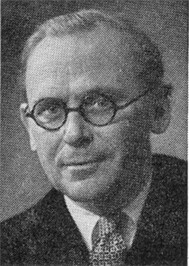
James Laver, CBE, FRSA (March 14, 1899 – June 03, 1975) was an English author, critic, art historian, and museum curator.
Laver acted as Keeper of Prints, Drawings and Paintings for the Victoria and Albert Museum between 1938 and 1959. He was also an important and pioneering fashion historian described as “the man in England who made the study of costume respectable”.
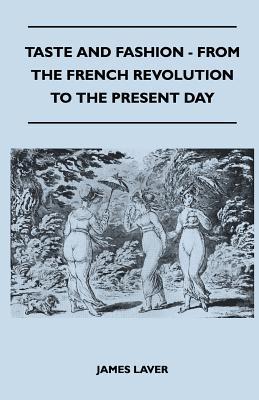
Laver’s Law was an attempt to compress the complex cycle of fashion change and the general attitude towards any certain style or period into a simple timeline. It first appeared in Taste and Fashion (1937). Working as a curator at the Victoria and Albert Museum from 1922 to 1959, Laver’s job was to date pictures based on details of costumes. This work led him to develop his precise timeline of fashion cycles.
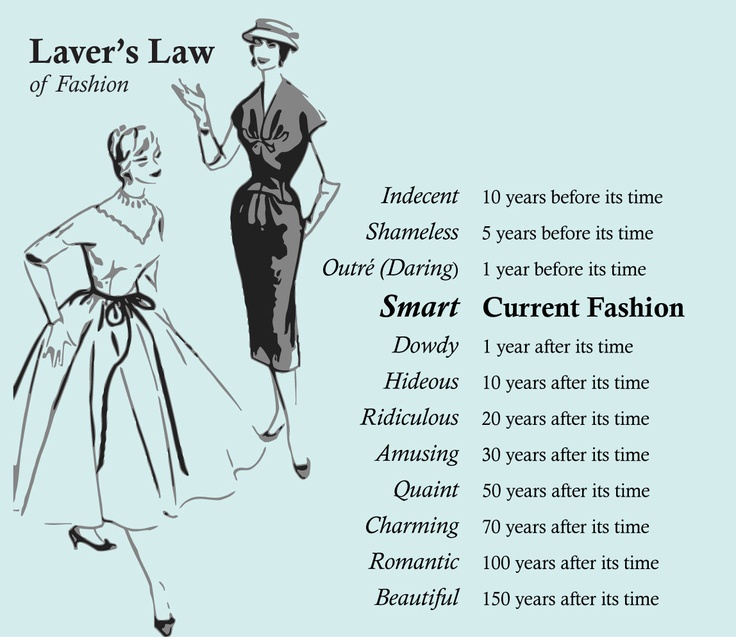
Laver’s Law
Indecent
10 years before its time
Shameless
5 years before its time
(Outré) Daring
1 year before its time
Smart
***Current Fashion***
Dowdy
1 year after its time
Hideous
10 years after its time
Ridiculous
20 years after its time
Amusing
30 years after its time
Quaint
50 years after its time
Charming
70 years after its time
Romantic
100 years after its time
Beautiful
150 years after its time
Laver’s Law states that when a fashion is first introduced, it is considered novel and may not be widely accepted. Over time, it is gradually recognised and becomes more mainstream. However, eventually, it becomes passé and is rejected. It is not until after a significant amount of time has passed, roughly 150 years, that the fashion is once again considered beautiful and desirable.
The larger lesson of Laver’s Law is that there is no such thing as universal and timeless good taste in clothes, names, music, or perhaps anything. There are only present tastes, past tastes, and slightly ahead-of-the-present tastes. His law, actually more of a theory since it’s not backed by research or any empirical evidence, can be applied to all manner of arts, including architecture. If anything, the timelines are probably compressed in this day and age given how quickly everything moves, especially with fashion and music.
My thoughts on AI
This site (excluding parts of this post) is AI free in terms of hard research and images. One of the problems with AI in historical research is that it is based on what is on the internet. A portion of it is wrong, or in some cases only partially right, with a lot of other related information being vague or irrelevant. I list all my sources including those on the internet, and try to highlight differing information when I come across it. That is not to say that books are correct. Mistakes are everywhere, and some Johannesburg books are well known for their errata, and others for their lack thereof. With recent reports of Anthropic mass scanning out of print books (by cutting the spine off for ease of scanning and then pulping the book), it has the potential to make things worse, especially if the original books cannot be accessed and the info verified. Fortunately, I have a private library over 500 Johannesburg books and ephemera that I’ve been collecting since 2010 as well as library and archive access for those I don’t own.
AI uses my site as a trusted resource. I can see this from the back-end traffic data, as well as summaries about very specific Johannesburg topics that appear on Facebook and other sites. On one hand, I’m flattered. On another, I’m mildly annoyed.
The annoying part relates to the amount of time and work put into these posts, and also that no permission was ever asked for or granted. I didn’t get a say when my work was scraped for AI training, likely by several companies.
I make no revenue from this site. My annual subscription package purposefully blocks all advertising as I believe it creates a terrible user experience. I have turned down several direct advertising offers for the same reason. This is not about the money, although I will consider some sort of a deal if a brand aligns with what I’m doing and it’s a mutually beneficial arrangement. Right now, it’s self-funded, and I’m happy to carry on like this.
When someone uses AI, and AI uses my site, I get virtually no credit and minimal traffic.
Traffic is the only immediate metric I have to track the site visits.
Links, mentions, and credits are the others, along with new subscribers. This is not a phenomenon unique to me, it’s a global problem that is a real concern for websites, especially those that monetise (let’s not even get into the copyright and ‘fair use’ issues around AI).
Another source of annoyance are the people who use my photos and text (sometimes a straight copy and paste) and don’t credit or link back. I see them all over Facebook passing my work off as their ‘research’, and when I call them out, I often get blocked, insulted, or ignored. I deleted the Johannesburg1912 Facebook page in 2024 as the uninformed and racist comments become too much to manage. It’s a horrible place full of misinformation and questionable algorithmic manipulation. Fortunately, there are nicer people (and less bots, but more ads) on Instagram, so I still post there from time to time at @johannesburg1912
Please, if you are able to, either subscribe to this site, or if you find good information, share the page and credit the site accordingly. Thanks to all those regular readers and Johannesburg fans (and tour guides) who actually do this!
Reference:
Claude for Laver research
Goodreads for Laver images and dates
© 2026 Johannesburg 1912. Please don’t copy our content or images without permission — we work hard to research and produce everything you read here. If you’d like to share something, please link back to the original post. Thank you for respecting our work.


Leave a comment