Hospital Hill and History of Hillbrow Pt.1 are the other two parts of the research.
This quaint little fire Station, completed in 1912, was originally the Northern Districts Fire Station Hillbrow is still operational and known as Berea Fire Station. It’s located at the top end of Banket Street near Louis Botha Avenue and the Raandjeslaagte beacon.


From the Wikipedia page c/o Bobby Shabangu: Designed by G. S. Burt Andrews, the foundation stone was laid on 15 October 1910 by Mrs D.W.Sims…who was the sister of Harry Graumann who was the mayor at that time, and the first Jewish mayor of Johannesburg. The first fire engines were horse-drawn and were later motorised. After World War 1, petrol-driven engines were used. The fireman’s quarters were rebuilt around 1960. The dormer windows and garages were later additions.


Across the road from the fire station in Banket street is Ridgeview. It was designed by Stucke & Harrison in 1931 and is a 1920s post-Edwardian classicism inspired apartment block before the Art Deco movement swept in and altered Johannesburg’s flatland.

Also of interest and connected to Ridgeview is the architect Theo Schaerer. He designed the Traansvaalsche Bank on the corner of Fox & Sauer Street in 1905, the German church on Twist street and did the alteration plans for the original German school (further up in the post). He appears to have owned two stands on the corners of East Avenue (now Louis Botha Ave), Willie street and Banket street along with a certain G. Muirhead, and lived in one of the houses – Possibly the one bordering Louis Botha Ave. It’s not known when the houses were designed or built, but he designed new stables and a garage in 1913 and did some alteration to the residence in 1914. Ridgeview, built in the 1930s, is now on the one stand and it’s possible from the picture above, that Schaerer’s house (or stable/garage) is what is visible on the other stand on the right. Today a half-circular block of flats is on that stand.

In 1966, for JHBs 80th birthday, the city engineers department straightened the northern end of Banket Street where it met East Avenue (Now Louis Botha Ave). The beacon was also renovated and given a new base. The plaque was unveiled on 4th October 1966.


Near the corner of East Avenue and Jager Street was Mr McIver’s Stable and Riding School. McIver dressed like Buffalo Bill and had a long moustache that twirled on either side of his face. His pupils would ride along Victoria Avenue in Parktown and down to the Sachsenwald Forest.
Clarendon Circle (named after Earl of Clarendon, Governor-General 1930-37) was an experiment in traffic control. The circle was meant to control traffic at the intersections of Twist Street, Empire Road, Park Lane and East Ave (now known as Louis Botha Ave).

From the City Engineer’s 1932 report: “Gyratory traffic control is obtained by means of this circle, 100 feet in diameter, with a minimum width of a carriageway at any point of 28 feet 9 inches. A pathway 6 feet wide provided on the outer circumference of the circle is divided from the inner portion, which has been laid out in lawns, palms and shrubs, but a low wrought iron railing set on a brick kerb with tile coping. At night the circle and its surroundings are brilliantly lit, and kerb lights consisting of red arrows indicate direction of traffic”


With the further increase of traffic and installation of traffic lights throughout the city, it was 25 years later that the intersection was redesigned and modernised by Bernard Carlsson. The circle was causing traffic delays of up to 20 minutes during peak periods and needed 5 pointsmen to direct traffic. It also took up most of the road which compounded the traffic problem.

On 6 May 1959 East Avenue’s name was changed to Clarendon Place. Interestingly Clarendon Place and Diagonal Street both line up with the western boundary of the original Raandjeslaagte triangle.
I lived in the three-story art deco building (Brenthurst Place) in the picture above between 1988-1991. Brenthurst Place was designed by P Hill Mitchelson in 1934 and was originally known as Clive Mansions.


Clarendon Place used to be where the Twist Street Tram terminus was and where policemen ‘Smiler Smith’ would stand on a soapbox and salute the motorists. Pamela Solarsh recalls an unsolved crime where the body of a Mr Dexter was found in the tram shelter. It was thought he was the victim of a hit and run accident.
The small tram terminus is located outside the entrance to Circle Court. The terminus building still stands but has been boarded up for many years.
Circle Court was designed by famous Art Deco architects Obel & Obel in 1934 and is still owned by one of their descendants.


Majestic Mansions on Clarendon Place was built in the mid-1920s and designed by Cowin, Powers, and Ellis. It was a distinctive four-story block of flats full of character. Each of the sixty flats were slightly different from each other.

It was demolished in the 1970s and replaced with two modern and taller blocks of flats (it can be seen in the picture above of the intersection from 2011). Below is an early drawing by Moross & Graff of the new Majestic Mansions from 1964. Some of the trees on the border dating back to the 1920s still survive.


On the corner of Clarendon Place and Caroline street is Christ Church. It was built in 1908 and designed by Gilbert St John Cottrill.


History of Hillbrow Pt.1 featured Ingram’s Pharmacy. Another famous pharmacy was Milton’s Pharmacy in Kotze street (who eventually bought out Fred Ingram and many other others as the area declined in the 80s and 90s).

Below is an excerpt from ‘The story of a pharmacist in Hillbrow: 1955 – 1997’:
“At that time Hillbrow was a vibrant, thriving and exciting cosmopolitan suburb, peopled mainly by Germans, Italians, Greeks and Britons. With trams and afterwards buses frequently passing through its streets, it was easily accessible. Because of its many tall buildings, Hillbrow was regarded as the most built-up area in South Africa. Within its comparatively small limits were parks, hospitals, nursing homes, opticians, dental and medical practices, two tailors, restaurants, continental styled cafés and lounges, interesting stores including bakeries and delicatessens, cinemas, theatres, hotels and night clubs.
Cyril’s Wardrobe was the favourite store for those with money. Milky Lane pioneered fresh fruit juices and milkshakes. Exclusive Books first opened in Hillbrow and was the Saturday night haunt of those in and outside the area who browsed through the books on the shelves while listening to softly playing classical music. The Porterhouse pioneered T-bone steaks and was a great favourite. Lionel Korp the optician, at great cost to himself, fed the pigeons every day and from noon onwards the overhead wires, poles and balconies in Kotze Street were filled with thousands of birds awaiting their lunch. It became one of the sights of Hillbrow. For those who needed to swim in winter, there was the Hillbrow indoor heated pool. Dating couples had the choice of going, among others, to the Ambassador Hotel or the Chelsea Hotel, where discothèques provided music, to the upmarket Summit Club, and to Fontana bakery at Highpoint which provided every kind of food for those still awake in the early hours of the morning.
Sam and his wife, along with other Hillbrovniks, made full use of the many cafés that made Hillbrow so attractive a place to live in. The Golden Ray Café was the first and oldest of them. Later, the Florian, Café Paris, Café Kranzler, Café Wien, Café Zurich and Café Pigalle enticed thousands to sit in their comfortable chairs on upstairs balconies or on their pavements and listen to music while drinking coffee, eating cake and reading newspapers from all over the world.
Nearby was the ‘Jo’burg Gen’ (later to become the Hillbrow Hospital when the Johannesburg Hospital moved to Parktown), and the Florence Nightingale Nursing Home.”

I remember both Sam Gluckman and Gerald Rubin from my teenage years in Hillbrow in the late 80s and early 90s as I was often visiting the dispensary collecting scripts for my hypochondriac mother.
Temple Israel Hillbrow still stands on the corner of Claim and Paul Nel Streets. This from their website: “According to The Star on December 28, 1933, the Liberal Jewish movement in South Africa… has purchased a site for the erection of a Liberal Jewish Synagogue in Johannesburg, the first in South Africa. “The site covers three-quarters of an acre, and is situated in Empire Road, corner of Hillside Road, just a few minutes from Clarendon Circle and Twist Street tram terminus.”

The foundation stone of Temple Israel was laid by the then Mayor of Johannesburg, Councilor Maurice Freeman, on 22 September 1935, and the official opening of the shul took place on 23 August 1936.” It was designed by architects Kallenbach, Kennedy and Furner.
Hillbrow’s alleys have always been seen in a negative light due to them being magnets for criminality. These alleys were originally sanitary lanes and were part of the planning of the suburb when it was still just residential homes. Examples of these sanitary lanes in their original setting can still be found in older suburbs like Brixton and Parktown North. Introduced by Samuel Goldreich who later regretted the error, the alleys were narrow lanes that ran through the blocks at the back of the houses where horse-drawn night soil wagons would collect and empty the household toilet buckets. This was all before waterborne sewerage systems. When Hillbrow and Braamfontein were being redeveloped in the 1940s – 1960s, these lanes remained even as high-rise flats and buildings took the place of the original suburban houses. I recall when living in Hillbrow that garbage trucks could drive through them and many buildings and businesses would have their bins at easy access for the trucks in the alleys. It kept the rubbish away from the pavements and building entrances. Many are now simply blocked off or access-controlled as they are still security risks.

Below are pictures of some surviving buildings and flats:


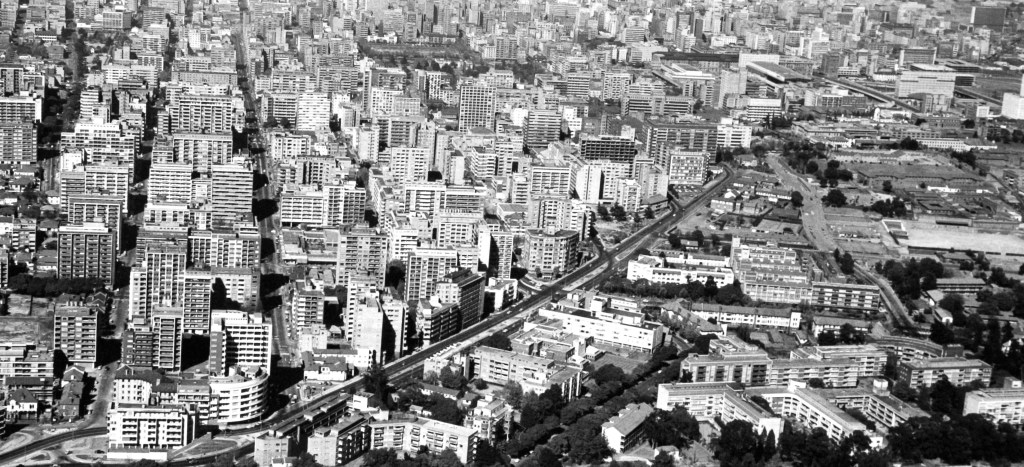
Although I don’t normally focus on anything past 1920, I do feel the need to add some later pictures of Hillbrow. As described earlier, it served as home for many people in its heyday between 1960-1990 and there seems to be a great demand for old and new pictures from this era. I’ve collected a whole lot (below) from various sources including John Stewart’s album on Facebook. Do visit the Facebook group ‘Who partied in Hillbrow between 1975 and 1990?’ for more and other Hillbrow groups. I lived in Hillbrow from 1987 – 1995 and do feel some level of nostalgia.


We frequented places like Café Three sisters, Café Wien, Café Kranzler, Golden Egg, Hillbrow Records, Look & Listen, Exclusive Books, Estoril Books, the underground Flea Market with Cosmi-Comics, Total Chaos, the gaming shop run by Alan Melville and the tattoo shop where I got my first – the Einsturzende Neubauten man with my (still) wife’s initials underneath. There was also the Mini Cine where we watched Pink Floyd’s ‘The Wall’, Clockwork Orange, Unbearable Lightness of Being, various Monty Python films and moshed upfront to ‘The Great Rock ‘n’ Roll Swindle’.


Anglo American Properties Highpoint development was designed by Monty Sack, Helmut Hentrich & E W N Mallows and built between 1971-1972 taking up the whole block. It comprised 29 storeys, 333 flats, 64 shops, and 81 offices by way of three levels for the shops, offices and the cinema topped off with the apartments. Various business premises were demolished for the new development including builders J. C. Dunbar, a Chinese laundry, Paddy Adiar’s garage, and the original post office.


I worked as a DJ at Bella Napoli downstairs from 91-93 and my wife and I lived in Kings Langley on Paul Nel street up to about 1995 until we eventually moved out of Hillbrow to Lauriston Court in Orange Grove.
Finally, here are a few views of Pretoria and Kotze street from December 2015. Most of Hillbrow, outside of a few well-known landmarks, is unrecognisable.


No post about Hillbrow is complete without the Hillbrow Tower. Construction began in June 1968 and went on for six days a week and 24 hours a day until it finally opened in April 1971. It’s the tallest structure in Africa at a height of 269 metres.
Back in April 1973, one could go to the top of Hillbrow Tower (known then as J. G. Strijdom Tower), have a four-course meal and a film for R5 and then get down to DJ John Roland and the energetic all-girl bar staff at Cloud 9.
It also had a revolving restaurant known as Heinrich’s. The restaurant floor revolved one to three times per hour in a counterclockwise direction. Even though it weighed 64 metric tons at full capacity, this smooth movement required only a three horsepower motor.
It was closed to the public in 1981 due to security concerns. I’ve been told the interior of the public places has been left as is for the last 40 years.


© 2016 Johannesburg 1912. Please don’t copy our content or images without permission — we work hard to research and produce everything you read here. If you’d like to share something, please link back to the original post. Thank you for respecting our work.
The following sites provided additional reference for the Hillbrow posts:
Reference:
Smith, A, 1971. Johannesburg Street Names. Johannesburg: Juta & Company, LTD
Norwich, O. I, 1986. A Johannesburg album-Historical postcards. Johannesburg: AD. Donker
Benjamin, A, 1979. Lost Johannesburg. Johannesburg: Macmillan
Chipkin, C. M, 1993. Johannesburg Style-Architecture & society 1880s-1960s. Cape Town: David Philip
Grant, G & Flinn, T, 1992. Watershed Town-History of the Johannesburg city engineers department. Johannesburg: Johannesburg City Council
Van Rensburg, C, 1986. Johannesburg – One Hundred Years. Johannesburg: Chris Van Rensburg Publications
Griffiths, G & Clay, P, 1980. Hillbrow. Details unknown
Hughes, L, 1978. Johannesburg-The Cosmpolitan City. Johannesburg: AD Donker
Robertson, C, 1986. Remebering Old Johannesburg. Johannesburg: AD Donker
Websites
http://www.dsj.co.za/en/about/history.html
http://www.jewishgen.org/safrica/newsletter/SA-SIG-NL-2007-06.pdf
http://www.jda.org.za/index.php/latest-news/46-news-2008/january
Notes:
Added Circle Court and Brenthurst Place photos and details.


Leave a Reply