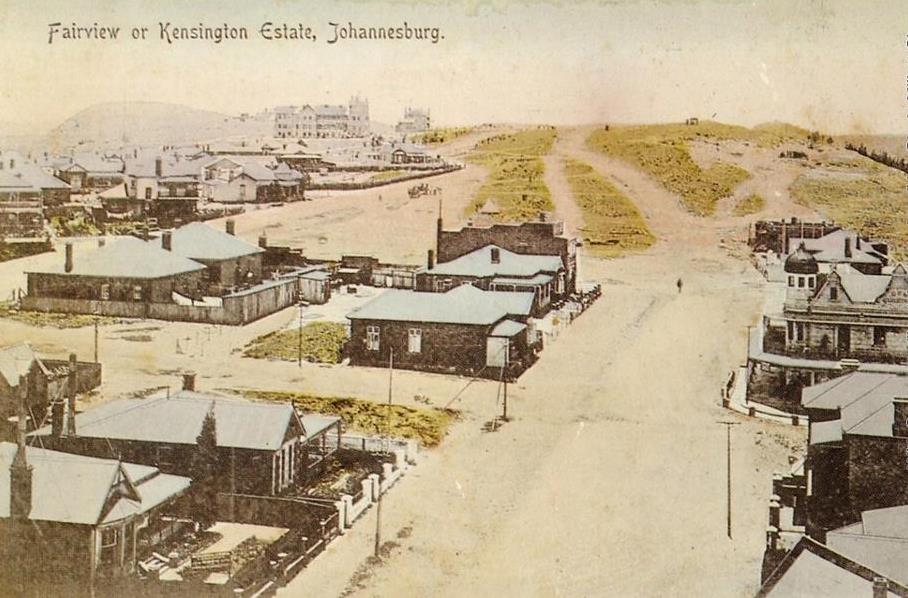
It was also once called Georgetown and Johannesburg Extension, but I didn’t want to push my luck adding this to the title.
This ‘blink and you’ll miss it’ suburb is wedged between Jeppestown on the south and Troyeville on the north and if traveling east along Commissioner Street is what you pass through before entering Kensington. One would be forgiven for thinking it was just part of Jeppe.
Interesting to note on the main picture above: Commissioner Street abruptly ends and becomes a series of veld tracks. In the background to the left is Kensington sanatorium. Also, note the Don Building on the bottom right which still stands today (pictures further down).

George E. Fawcus got permission from the government in 1889 to lay out a township. In 1891 he applied to have it canceled as he couldn’t afford to pay the stand license. This was granted and the area became a public digging which didn’t suit those that had already built their homes and were living n the area. Fawcus went to the mining commissioner for help who then refused to renew the licenses of the prospectors (that had already pegged 23 claims on the land. As the government had made a mistake by not de-proclaiming the residential area, Fawcus sued ZAR. On 16 April 1895 the court fined the government. Early in 1896 the area was surveyed again and the original owners were given their sites back. In November of the same year, the rest of the stands went up for sale advertised as ‘the last opportunity of buying stands in what is known as the town of Johannesburg’. George Kent, once a part-owner due to the previously mentioned digging claims, named the township Fairview. It was still referred to as ‘Fawcus’ well into the 1920s.
Fawcus lived in Jeppestown and once he had made enough money out of Fairview, he retired with his family to Trinidad where he died a few years later. His wife returned in 1912 and lived in a house she already owned in Fairview. She, along with G. A. Leyd’s wife, also tried unsuccessfully to change the name to Fawcus Township.
It developed into a good middle-class suburb popular with miners. Over the years, like other suburbs close to the city, light industry infiltrated, especially along Commissioner Street, and the suburb generally slipped to sub-economic level. Unlike its neighbours Kensington, Belgravia, and Jeppestown: Fairview was never planted with trees giving it a bare appearance.
Although a small suburb, there are a few significant examples of architecture. I’ve included a few examples of houses at the bottom end on Op De Bergen street which could also technically form part of Troyeville. It differs depending on the reference, but I have left the balance of Op De Bergen street for the Troyeville post. It’s possible that the one side of Op De Bergen Street falls under Fairview and the other under Troyeville.
Dutch Reformed Church

The cornerstone of the church was laid by General J. H. de la Rey on 2 May 1906 and was inaugurated on 26 January 1907. Kallenbach & Reynolds prepared the plans. Kallenbach, who settled in Johannesburg in 1896 designed several churches.

This church was designed in the shape of a Greek cross to suit the square dimensions of the plot of land. The use of arched windows points to Romanesque revival of the late 19th century, while the white plaster accents around the windows and gables are Victorian. The ‘pencil point’ tower is an early example of a typical South African steeple and a feature of many churches built right up to the 1960s. The church was renovated in the 1960s and declared a national monument on 9 March 1973.
Frizelle House

Frizelle House was once the home of master plumber Sam Frizelle. His business was run out of the house next door. He came to SA just before the Anglo-Boer War and along with his son and partner, formed a business called Frizelle & Welch. The house (which once had striking cast-iron railings) is severely neglected. The semis next door are very much British Colonial (pitched roof, decorative gables) with a hint of Karoo Afrikaans (curved corrugated iron awnings supported by pillars).

Any hopes of restoration are lost. The balconies are gone and a new facade/plastering arrangement has taken its place. The house is right at the bottom end of Op De Bergen Street where many of the remaining houses are sadly in poor condition.
Don Building


The Don building housed the original Gray & Smith grocery store. Today it’s still in pretty good condition and is a restaurant.
Fire Station Tower


Johannesburg’s first fire station was completed on this site in 1906. The thirty-five-metre tower was used as a lookout for spotting fires before the advent of telecommunications and also for drying out fire hoses that were hung in the tower. When the station was rebuilt in the early 1980s, only the watchtower was kept. It is Johannesburg’s only remaining fire tower and the highest of a group of towers in the area. Info from http://www.blueplaques.co.za. Further research shows that this may be the same fire station referred to as the ‘Eastern District Fire Station’ which was designed by David Ivor Lewis.

Julius Jeppe laid the foundation stone in 1905 and the tower is a protected national monument today.
Two views 107 years apart


Special thanks to the Captain of Fairview Fire Station who let us take pictures from the top of their training tower. It’s exactly the same height as the original fire tower but about 50 metres to the right. I was up there with James Ball from the Heritage Portal and we had a discussion about a fund-raising effort to increase the erection of blue plaque sites. More on that in another post…
Various houses and shops


© 2013 Johannesburg 1912. Please don’t copy our content or images without permission — we work hard to research and produce everything you read here. If you’d like to share something, please link back to the original post. Thank you for respecting our work.


 Johannesburg 1912 - suburb by suburb research
Leave a reply to Patrick Button Cancel reply